The next payment is still an estimate
Keep amount and timing assumptions separate before assigning expected money.
An independent household timing publication
Put the week in view.
Give the next bill some room.
A fictional week, viewed as decisions
Find its current amount and actual due date.
Verify the intended method and its timing.
Keep future essentials visible in the household plan.
A question or requested change is not a confirmed arrangement.
The idea worth keeping
A reserve label helps describe what money needs to cover. It does not create another balance or a provider feature.
Follow the fictional reserve example →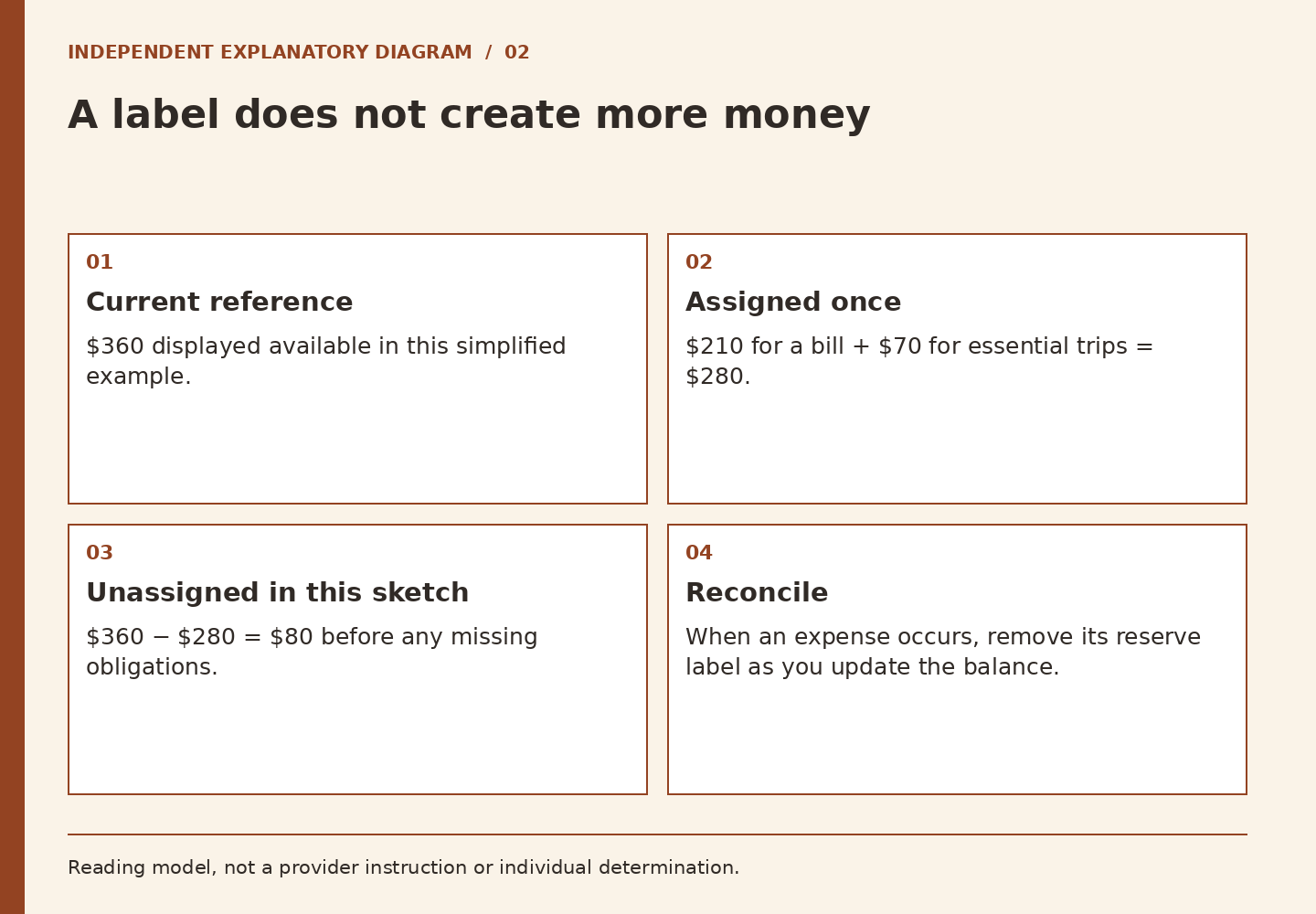
Keep amount and timing assumptions separate before assigning expected money.
Ask about the transition cycle, not just the new date.
Bring the preparation period onto the calendar before the final week.
A small decision aid
Choose the pressure point and your planning stage. The result is a set of specific questions, not a budget calculation. No amounts, names, account details, or uploads are requested.
LOCAL READING AID / NO PERSONAL INPUT
Choose one household timing pressure and where you are in addressing it. Get topic-specific questions and a compact planning record. This local aid does not calculate available money, recommend borrowing, move a due date, contact anyone, or assess an account.
Choose a pressure point below. Name the earliest affected obligation, verify the actual dates with their owners, and update the household plan only from confirmed information. Promptly report urgent loss, fraud, or wage concerns through the appropriate official route.
Choices stay in page memory. No submission, tool storage or URL change. Browser-managed form restoration may behave independently. External source links follow their own policies. Source context checked October 7, 2026.
Twelve original guides
12 articles
Build the calendar
Map the date a bill must be satisfied separately from the earlier date you need to verify and prepare its payment.
Read the article : Give Every Bill a Due Date and a Decision DateRead the available room
Keep money assigned to a future obligation distinct from an account’s displayed balance without counting either amount twice.
Read the article : A Household Reserve Is a Plan, Not a Second BalanceHandle uneven income
Create a conservative planning view that keeps expected income amounts and arrival assumptions visible.
Read the article : Plan Variable Pay in Windows Instead of One Confident NumberBuild the calendar
Place actual calendar dates beside weekly income and monthly obligations before using averages to describe the month.
Read the article : Bridge Weekly Paychecks and Monthly Bills Without an Average-Month ShortcutHandle uneven income
Check employer, biller, and service schedules independently when a holiday falls near a household payment decision.
Read the article : Mark Holiday Timing as a Question Until the Schedule Is ConfirmedChange one pressure point
Prepare a due-date-change question that includes the first affected cycle, interim payment, and any cost difference.
Read the article : Ask to Move a Bill Date Without Accidentally Losing the Transition MonthPrepare for less frequent costs
Map an irregular known expense to its preparation period without inventing a universal savings target.
Read the article : Bring an Annual Expense Into the Weeks Before It ArrivesShare the calendar
Create a household view that preserves each adult’s agreed contribution date and avoids assumptions about access to their funds.
Read the article : Coordinate Two Income Rhythms Without Treating Them as One PaydayHandle uneven income
Show the gap between paying an expense and receiving a reimbursement without counting an expected credit as current resources.
Read the article : Keep a Promised Reimbursement Out of the Money-Available ColumnChange one pressure point
Identify the first affected obligation and prepare a prompt, bounded inquiry instead of disguising a gap with optimistic timing.
Read the article : Turn a Projected Shortfall Into a Specific ConversationShare the calendar
Review new evidence and the next decision window using a short repeatable household routine.
Read the article : Run a Ten-Minute Calendar Review That Ends With One Useful ChangePrepare for less frequent costs
Map essential repeat purchases by the number of days they need to cover instead of assuming every pay interval is the same.
Read the article : Keep the Days Between Paychecks Visible When the Month Feels Longer